/ July 2015
Baking & Snack
31
equipment. When possible, engineers replaced flat
or square surfaces with sloped, angled or inclined
ones to prevent flour from building up and for easy
removal during maintenance and cleaning. Even the
new GBS high-speed mixer sits on an angled platform
to control vibration and prevent water from seeping
between the mixer and the floor.
Not only clean … lean
According to Mr. Kugler, the new bun line is so techno-
logically advanced that it takes only four people — in-
cluding a shift supervisor — to operate it. An additional
12 employees per shift handle finished buns and rolls
in the centralized packaging department, which serves
both production lines.
In all, 103 employees — including office personnel —
work in the Bönen bakery. Four shifts — two on each
line — operate up to 10 days straight before the facil-
ity shuts down for cleaning and preventive maintenance.
That process typically takes only two shifts before the
bakery is up and running again.
During
Baking & Snack’
s tour of the facility earlier
this year, Mr. Kugler took time to highlight the similari-
ties and differences of the two lines — specifically noting
how they are integrated in the front in ingredient han-
dling and in the back in packaging.
Software from an AZO ingredient handling system
controls formulas and metering of wet and dry in-
gredients prior to mixing. Bulk systems include three
60-tonne flour silos and one 30-tonne salt silo as well
as two 30,000-liter tanks — one for liquid sugar and an-
other for soybean oil. Four AZO 30,000-liter cream yeast
systems feed the two production lines.
An AZO liquid sour system combines flour, water,
yeast, sugar and oil into three tanks to create the sponge.
After two hours of fermentation, the 32°C sponge passes
through a heat exchanger that reduces its temperature to
5°C. The batch is then transferred to one of two holding
tanks. “Those two tanks serve both lines,” Mr. Kugler ob-
served. “As one empties, the other gets ready to continue
production.”
Wback relies on GBS high-speed mixers on both
lines. Employing the high-speed Chorleywood process,
the mixers take only 4 to 5 minutes to create 370-kg
batches. “The difference is that we mix to energy, not
time,” Mr. Kugler observed. “We check the watts per
kilo to determine when the dough is complete.”
For buns, the predetermined target is 10.5 watt
hours per kg — or about 3,800 watt hours per batch.
The mixer uses chilled water if the incoming flour tem-
perature is too warm. “With this process, we always
have the same dough quality,” he added.
It takes 14 batches to produce 50,000 buns an hour.
After the mixer discharges the dough, it tumbles into
an AMF dough pump. To reduce shear, the new dough
pump on Line No. 2 is Teflon-coated while the older
model on the original line is stainless steel.
The dough is then pumped into an AMF HBDFlex
six-pocket divider with a twin-screw “vector” extru-
sion system, which consistently feeds the metering
manifold. Servo-controlled metering pumps accu-
rately portion the dough pieces. The line relies on a
recipe-driven setup to expedite changeovers.
From dividing, the dough pieces travel through
rounder bars and a flour duster, then into an inter-
mediate proofer for 2.5 minutes. The bakery typically
uses four rounder bars for hot dog buns and six for
hamburger buns. To reduce labor, a Burford Orbital
Pan Shaker automatically aligns the pieces before the
pans travel into a Stewart Systems dual-spiral proofer
with the latest control package.
After passing through an optional Burford Smart
Seeder or water splitter, the pans enter the Stewart
System conveyorized oven with a low-profile, double-
loop design to provide what Mr. Kugler described as a
seamless bake at a consistent temperature. Buns bake
consistently across the pan for 7.5 to 9 minutes at
255°C, with the time depending on the product variety.
Before vacuum depanning, a GBS system provides
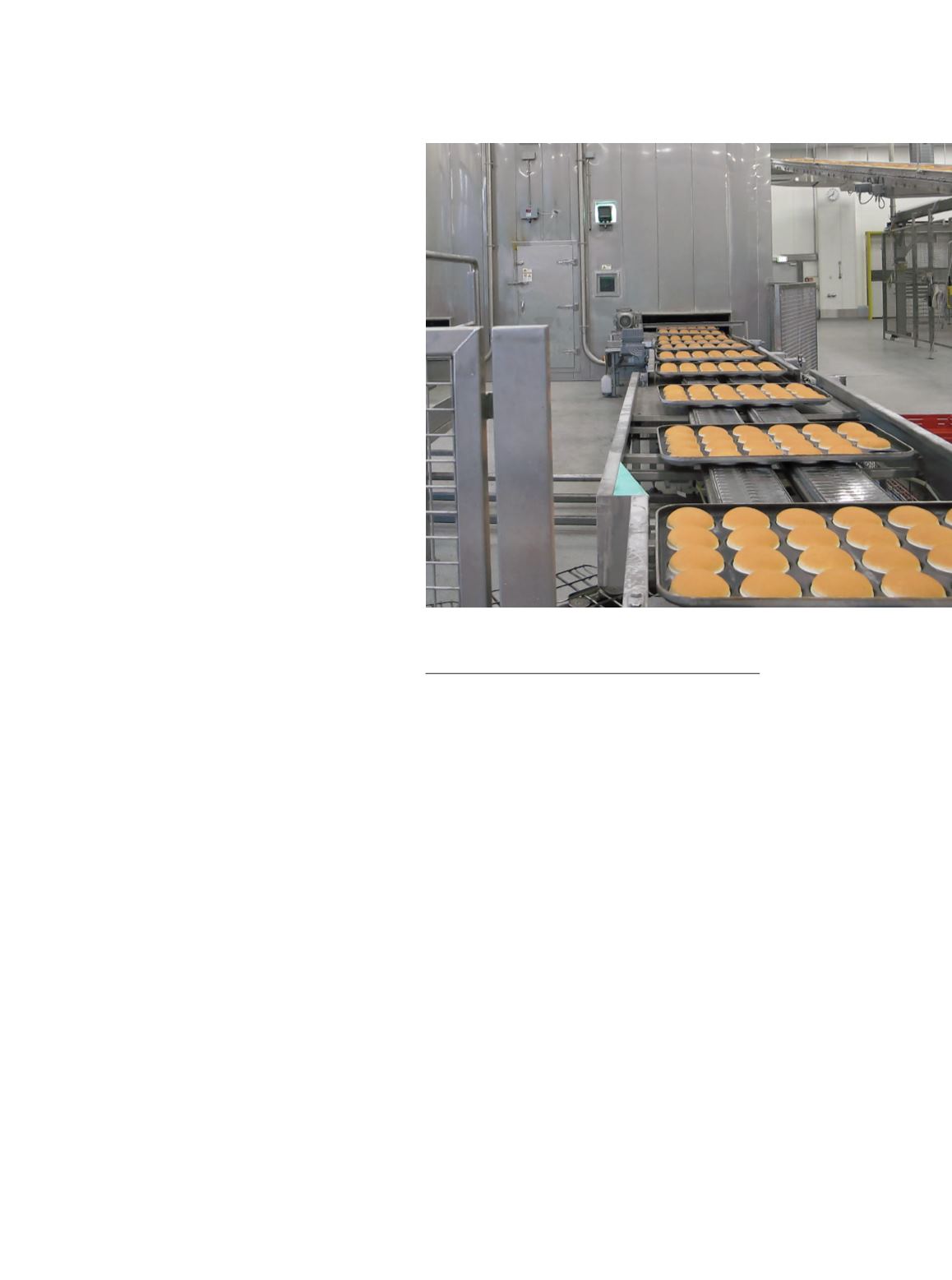
Wback prides itself on producing consistent, high-quality buns in a sanitary,
food-safe environment. Here, on the brand new line in Germany, more than 800
buns leave the oven per minute — or more than 50,000 an hour.


